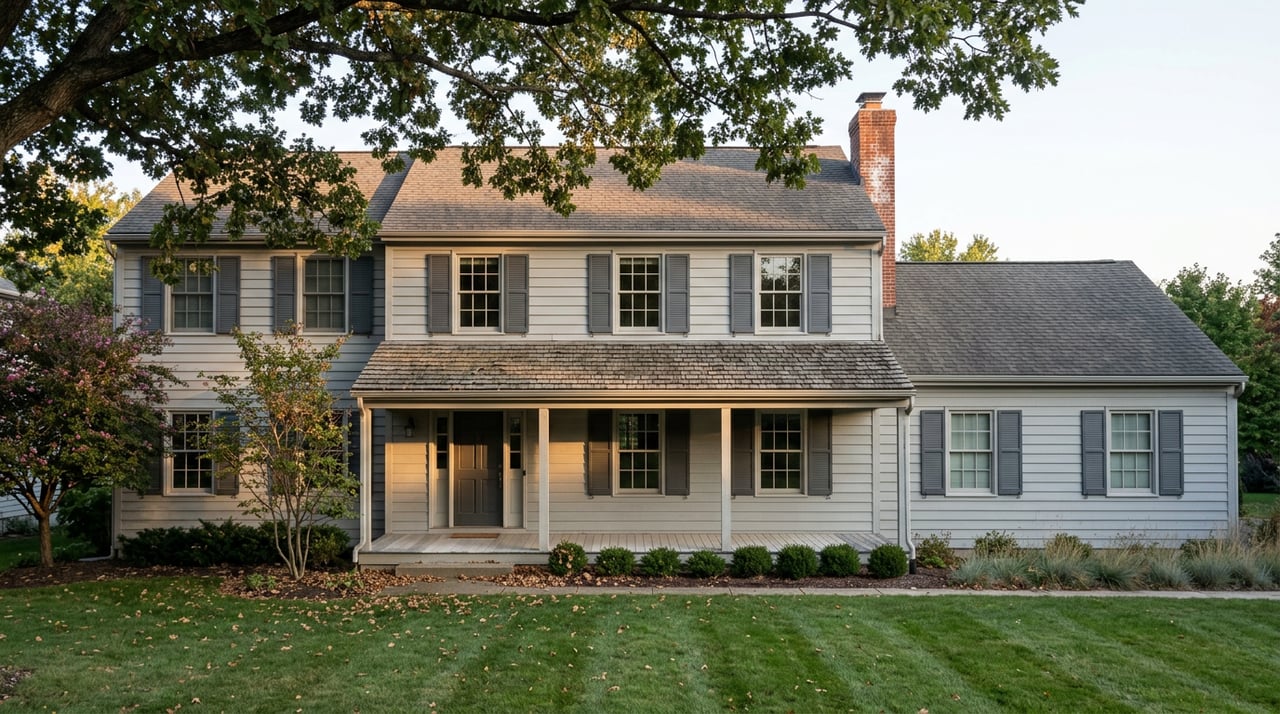
Why Black Hawk County's New Homestead Exemption Won't Close the Waterloo-Cedar Falls Tax Gap
September 24, 2026
September 24, 2026
If you're comparing a home in Waterloo to one in Cedar Falls, you've probably already pulled up the sale prices. Have you pulled up the tax rate?
Most buyers don't, until the first bill arrives. That's a problem in Black Hawk County specifically, because the two cities don't just have different home prices. They run on tax rates that sit roughly 35 percent apart, and a new state law signed this year changes the math on both sides without closing that gap.
Black Hawk County's own property tax explanation page states it plainly: most property owners in the city of Waterloo pay about $45.74 for every $1,000 of taxable value, while most Cedar Falls taxpayers pay about $33.93 per $1,000. That's the rate the county published for fiscal year 2026, applied to property values as of January 1, 2024, payable in two installments, September 2025 and March 2026. Rates get set fresh every year, so the figure covering the bill going out this month is worth confirming directly with the county, but the FY26 numbers are the clearest published benchmark for how far apart these two cities run.
Countywide averages tend to smooth that difference away. A blended effective rate for Black Hawk County as a whole lands well above the national median, but a single county figure can't tell you which city you're buying into. Waterloo and Cedar Falls aren't close on this number. They're not even in the same neighborhood of the number.
Take two homes assessed at $150,000, one in each city, and run them through Iowa's rollback system. For fiscal year 2026, the state applied a residential rollback of 47.4316 percent, meaning only that share of assessed value was taxable. That puts both homes at a taxable value of roughly $71,147 before any credits.
Apply the outgoing homestead credit, which functions like a $4,850 reduction in taxable value, and the two bills separate:
| Taxable value after credit | Rate per $1,000 | Estimated annual tax | |
|---|---|---|---|
| Waterloo | ~$66,297 | $45.74 | ~$3,032 |
| Cedar Falls | ~$66,297 | $33.93 | ~$2,250 |
That's a gap of about $782 a year, or roughly $65 a month, on two homes with identical assessed values. Same square footage, same rollback, same credit. The only difference is which side of the city line the parcel sits on.
That $65-a-month difference isn't a fixed feature of the county. It's a number that shifts every budget cycle, and it has already moved in a direction worth knowing about. The Waterloo-Cedar Falls Courier reported on Iowa Department of Management data showing Waterloo's and Cedar Falls's property tax rates moving in opposite directions in a recent cycle, not converging, diverging.
That matters for anyone planning a purchase around a specific monthly payment. The rate you see quoted today reflects decisions city councils made months ago, and it can move again before your first tax bill shows up. If you're weighing two comparably priced homes across the county line, the honest move is to call the County Auditor's Office and confirm the current levy for the specific taxing district, not just the city, since school district and other local levies can vary within a single city's boundaries.
In May 2026, Governor Kim Reynolds signed Senate File 2472, one of the largest overhauls of Iowa's property tax system in years. The piece that affects individual homeowners most directly is the homestead exemption. Starting with assessment year 2026, Iowa replaces the old homestead credit with a percentage-based exemption: 10 percent of a home's taxable value, with a floor of $5,500 and a cap starting at $20,000 that adjusts for inflation.
That's a bigger benefit than what it replaces. The old credit worked out to the equivalent of taxes on $4,850 of value. The new exemption's floor alone is higher than that, and for most homes the 10 percent calculation will exceed the floor entirely.
Here's the part that matters for planning purposes: this change is retroactive to assessment year 2026, but it doesn't show up on a tax bill until property taxes payable in September 2027 and March 2028. The bill landing in mailboxes this September and next March still runs on the old credit. If you're comparing what you'll pay today against what you'll pay in two years, don't use the same formula for both.
Run the new exemption through a lower-valued home and the mechanics look different than they did on the $150,000 example above. Take an $85,000 assessed home. At the same 47.4316 percent rollback, taxable value comes to about $40,317. Ten percent of that is roughly $4,032, which falls short of the $5,500 floor, so the floor applies instead. That $5,500 exemption equals about 13.6 percent of taxable value, a bigger percentage cut than the flat 10 percent a higher-valued home receives.
In practice, that means the new law is mildly progressive by design. A starter-priced home anywhere in the county gets proportionally more relief than a higher-valued one, because the floor does more work at the bottom of the price range than the percentage formula does. Worth knowing whether you're the buyer or the one explaining the bill to a buyer.
The exemption doesn't appear out of nowhere. The state is phasing out reimbursement payments to local governments that used to offset the old credit, with that funding fully repealed by 2030. At the same time, SF 2472 caps most city and county general fund revenue growth at 2 percent annually starting with the 2027-2028 fiscal year, though new construction is exempt from that cap.
That last detail is the one to watch locally. Cities adding a lot of new construction can grow their tax base around the cap. Cities that aren't building much have less room to offset lost homestead revenue, and some city officials elsewhere in Iowa, including Dubuque's mayor, have said publicly that an aging population claiming more senior exemptions could shrink the tax base further over time. Nobody can say today exactly how Waterloo or Cedar Falls will respond in their next budget cycle, but the incentive structure is now in place for growth and non-growth cities to diverge even more than they already have.
Does the $45.74 versus $33.93 gap apply to every property in each city? Those were the fiscal year 2026 rates Black Hawk County published for most property owners in each city. Individual parcels can also fall into different taxing districts depending on school district and other overlapping levies, and the rate resets every year. Confirm the current figure for your parcel with the County Auditor's Office rather than assuming last cycle's city-wide number still applies exactly.
Will Waterloo's rate keep falling while Cedar Falls's keeps rising? There's no way to promise that. Rates are set annually and have moved in opposite directions before. The new 2 percent revenue cap and the phase-out of state reimbursement funds for the homestead exemption both add pressure that could affect the two cities differently going forward, which is exactly why it's worth checking the current year's numbers before you close rather than relying on last year's.
Does any of this affect farmland or rental property the same way? No. The homestead exemption applies to owner-occupied primary residences. Agricultural property uses a separate rollback percentage, and rental or investment property doesn't qualify for the homestead exemption at all. If you're evaluating a rural parcel or a rental in Black Hawk County, the residential math in this post doesn't transfer directly.
The county-wide tax numbers you'll find first tell you what an average bill looks like. They don't tell you what your bill will look like on a specific street, in a specific taxing district, at a specific price point, under a law that's still two years from showing up on paper. That's the gap between a portal search and a conversation with someone who tracks this county for a living.
If you're weighing a purchase in Waterloo, Cedar Falls, or anywhere else across Black Hawk County and want help running the real numbers on a specific property, Wapsie Realty can walk through it with you before you write an offer, not after the first tax bill surprises you.
Stay up to date on the latest real estate trends.

We pride ourselves in providing personalized solutions that bring our clients closer to their dream properties and enhance their long-term wealth.