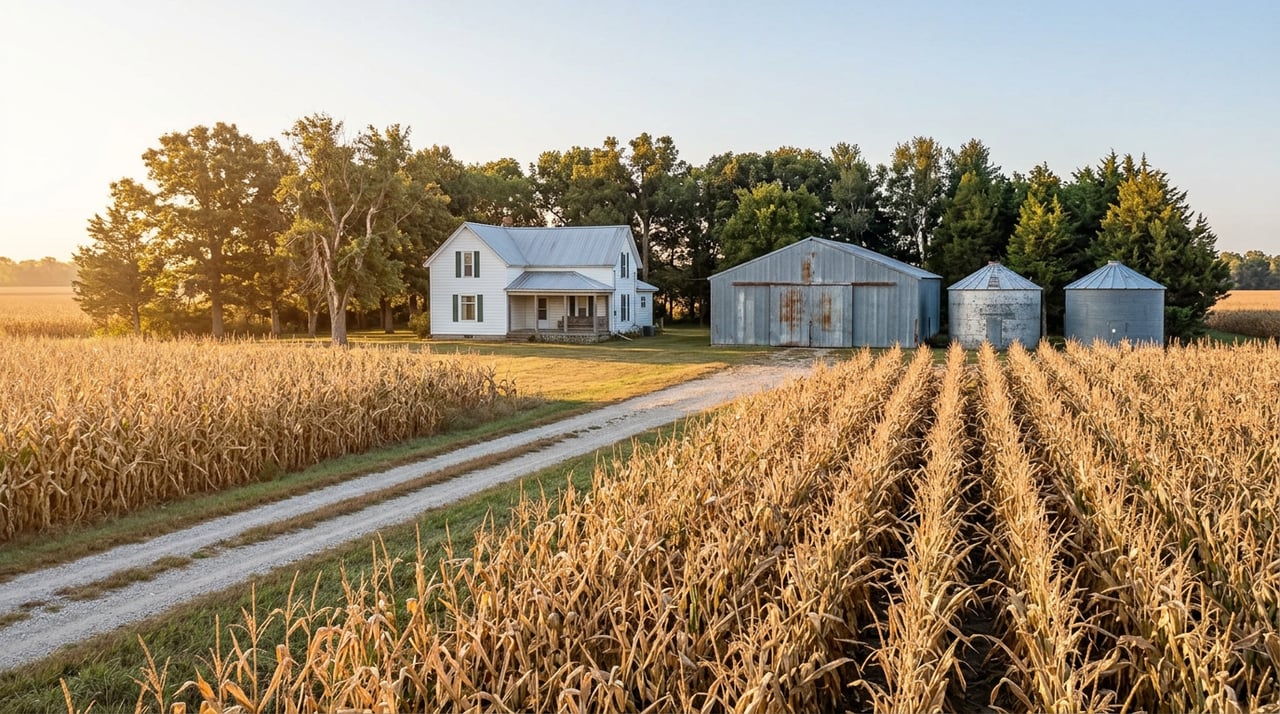
Buchanan County Farmland Prices: What Local Sales Reveal
September 3, 2026
September 3, 2026
If you read one farmland headline out of Iowa in the past year, it was probably some version of "values basically flat." The Iowa State University Land Value Survey, released every December and treated as the closest thing the state has to an official scorecard, put the 2025 statewide average at $11,549 per acre, up just 0.7% from $11,467 in 2024. Economist Rabail Chandio, who runs the survey out of ISU's Center for Agricultural and Rural Development, called anything under 5% a market adjustment rather than a real shift, and that's the number that traveled: a quiet year, a market catching its breath after 2024's 3.1% dip.
Buchanan County did not have a quiet year. Neither did the rest of the district it sits in.
Statewide averages are built by blending nine crop reporting districts, and in 2025 those districts moved in almost opposite directions. North central Iowa posted the sharpest decline of any district, down 2.6%. Central Iowa fell too. But northeast Iowa, the district that includes Buchanan, Black Hawk, Delaware, Dubuque, Clayton, Allamakee, and their neighbors, posted the largest increase of any district in the state: up 4.1%, a gain of $481 per acre. Within that district, Clayton and Allamakee counties led the whole state in percentage growth at 4.4%, and Dubuque County had the largest single dollar gain in the district at $553 per acre.
Chandio's read on why some regions climbed while others slid was straightforward: livestock income cushioned areas that had it, while places more dependent on row-crop margins alone felt the full weight of soft corn and soybean prices. "The market is still feeling the weight of the rate hikes from 2022 and 2023," she told Iowa Farm Bureau, noting that interest rate effects can take up to a decade to fully work through land values. Just over six in ten survey respondents said they thought current land values were too high or way too high, even in a year the average barely moved. That's not the profile of a market coasting along at 0.7%. It's a market where the average is hiding two different stories at once, and Buchanan County landed on the stronger side of the split.
The district number is still one level removed from what actually happens at an auction. To see the real texture, look at what sold in Buchanan County itself over a few weeks this past summer.
| Sale window | Tract | Soil / use | Price per acre |
|---|---|---|---|
| Aug 1–7, 2026 | 79 acres, about 50 tillable | CSR2 64.3, tillable-recreational | $10,000 |
| Aug 8–14, 2026 | 33.75 acres, about 31 tillable | CSR2 88.9 | $11,500 |
| Reported July 2026 | 39-acre cropland tract (part of a 51-acre farm sold in two tracts) | CSR2 82.6, 96% tillable | $16,196 |
Look closely at that middle row against the bottom row. The 33.75-acre tract had a higher CSR2 score, 88.9 versus 82.6, and still sold for roughly $4,700 less per acre than the cropland tract from the July sale. If CSR2 alone set the price, the order should have run the other way.
It didn't, because the July sale wasn't really one transaction. It was a 51-acre farm split into two tracts and auctioned separately: a pure 39-acre cropland piece and a 12-acre site carrying a four-bedroom home, more than 270,000 bushels of grain storage, and several outbuildings. Bidders competing for the cropland tract were pricing production value alone, with no house or bins to weigh down or complicate the number. That's how a smaller, cleaner tract with a slightly lower soil score still commanded the highest per-acre price of the three.
None of this shows up if you stop at "Buchanan County averaged $12,671 an acre," which is where the last full county-level figure sat as of the December 2024 survey, down $481 from the year before. That number is a real data point and a useful historical marker. It is also an average of everything from timber-heavy recreational ground to full-tillable row-crop tracts, and by the time you're standing at an actual auction in 2026, it tells you almost nothing about what your specific acres, or the specific acres you're bidding on, are likely to bring.
The pattern holding across Iowa auctions this year is the same one showing up inside Buchanan County: tract size, tillable percentage, whether the ground is being sold whole or split into pieces, and how many buyers show up for that particular combination all matter more than any single county or state figure. A farm with a lower soil score but a clean, contiguous, well-positioned tract can out-price a higher-scoring parcel that comes bundled with buildings, a home site, or acreage that isn't fully tillable. Recreational ground along a stretch like the Wapsipinicon River, where properties near Independence have traded on hunting access and timber as much as row-crop potential, follows an entirely different pricing logic than a flat quarter-section a few miles away.
If you're sitting on farmland in Buchanan County and thinking about what it's worth, the district trend is genuinely good news: you're in the part of the state that outgrew everyone else last year, not the part that slid. But that trend is a tailwind, not a price tag. The number that actually matters is what a buyer will pay for your specific acres, with your specific CSR2 score, your specific tillable percentage, and your specific mix of cropland versus recreational or building ground, sold the way that generates the most competition for that particular parcel.
That's also the question a buyer needs answered before making an offer. A property advertised at "around the county average" might be priced well above or below what its actual soil and use profile supports, and the only way to know is to look at comparable recent sales with a similar tillable share and CSR2 range, not the countywide number from a survey conducted the previous November.
This is where having someone in your corner who has actually walked farmland, worked with lenders on rural financing, and handled the renovation and outbuilding side of these properties earns its keep. It's also part of what Travis Wiley brings to the table at Wapsie Realty alongside residential, commercial, and recreational property work: an understanding that a Buchanan County acreage sale isn't one market, it's several markets stacked on top of each other, and the right strategy depends on knowing which one your property actually belongs to.
Does the countywide average apply to my specific parcel? Not reliably. The county figure blends tillable row-crop ground, pasture, timber, and recreational acreage into one number. Two tracts a few miles apart, or even split from the same farm, can sell for a difference of several thousand dollars per acre depending on soil quality, tillable percentage, and whether buildings or a home site are included.
Is a higher CSR2 score always worth a higher price? Not by itself. CSR2 is one input among several. Tract size, how the sale is structured (whole farm versus split tracts), and the number of competing buyers for that specific combination of features can outweigh a soil score difference of ten or more points.
Why did northeast Iowa do better than other parts of the state in 2025? Chandio pointed to livestock income providing more stability in regions that have it, while areas leaning more heavily on row-crop margins alone felt more pressure from soft commodity prices and lingering high interest rates.
If you're weighing a farmland purchase or sale in Buchanan County, or trying to make sense of what a specific parcel near Independence, Winthrop, Jesup, or Quasqueton is actually worth in today's market, Wapsie Realty can walk through the comparable sales and property specifics with you. Contact Us.
Stay up to date on the latest real estate trends.

We pride ourselves in providing personalized solutions that bring our clients closer to their dream properties and enhance their long-term wealth.